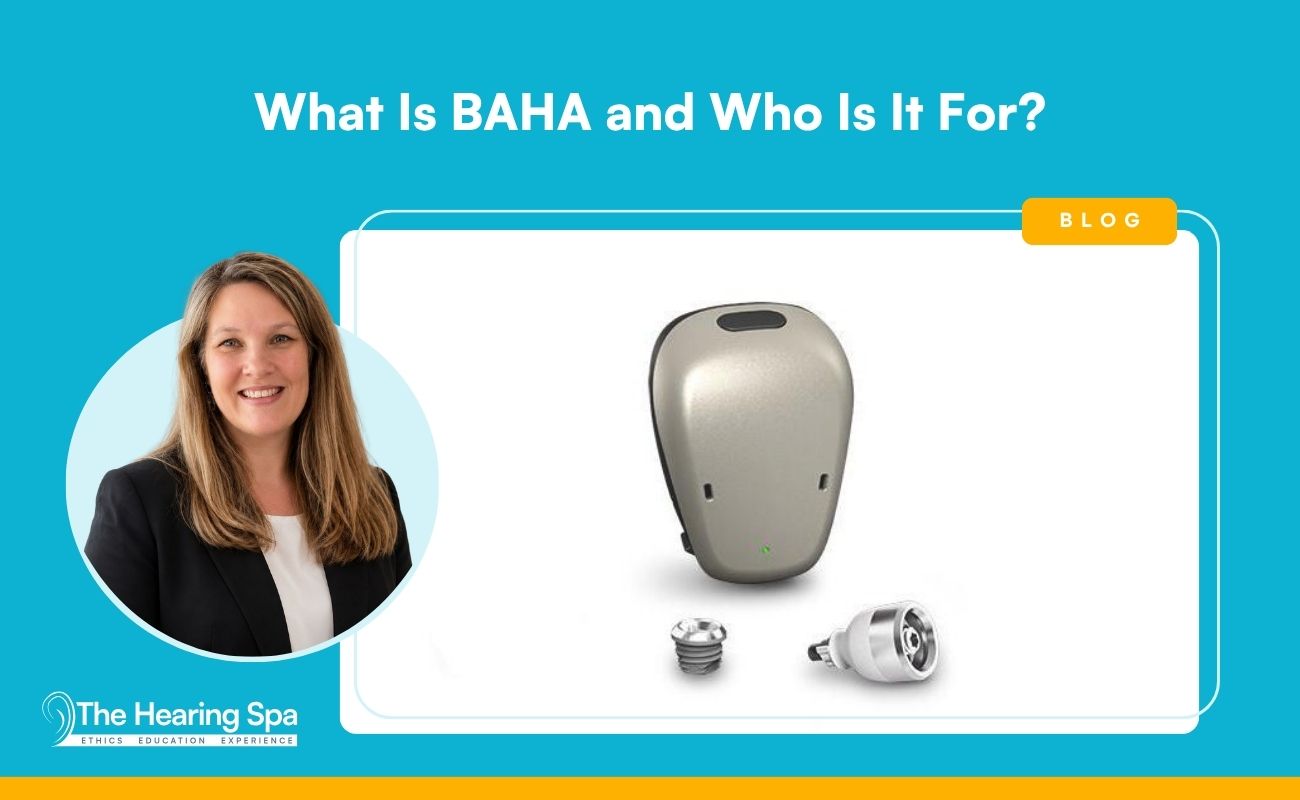
Most people picture hearing aids as small devices tucked into or behind the ear. They amplify sound and send it through the ear canal, and for many people, that works well. But for others, the ear canal is too narrow, absent, or blocked. The middle ear may be damaged in a way that amplification can't fix. When that's the case, a completely different solution exists: BAHA, or bone-anchored hearing aid.
How BAHA Actually Works
Instead of pushing sound through your ear canal, BAHA bypasses it entirely. It sends vibrations directly to your inner ear through your skull bone, a process called bone conduction. This sounds more high-tech than it is. You already experience bone conduction every day; it's part of why your voice sounds different on a recording than it does inside your own head.
The system has two parts. A small titanium implant is placed surgically into the bone behind your ear. Over a few months, that implant fuses with the surrounding bone and your body essentially adopts it. Once that process is complete, a sound processor clips onto the implant and gets programmed specifically for your hearing needs.
Who Should Consider BAHA
BAHA isn't a universal fix. It's designed for specific situations where conventional hearing aids simply can't do the job:
- Conductive hearing loss — your inner ear works fine, but sound can't reach it because of problems in the outer or middle ear
- Mixed hearing loss — a combination of conductive issues and inner ear damage
- Single-sided deafness — one ear has little to no usable hearing
- Narrow or absent ear canals — whether you were born that way or it resulted from surgery
- Chronic ear infections — traditional hearing aids sit in the ear canal and can trap moisture, making repeated infections worse; BAHA goes around the ear canal entirely
If you've been told your hearing loss is "too complex" for standard hearing aids, that's worth a second look. BAHA has been FDA-approved since 1977 and has helped thousands of people who thought they'd run out of options.
What the Programming Process Looks Like
Surgery is handled by an ENT. Our role begins once the implant has healed, usually a few months after the procedure, and it's time to fit and program the sound processor.
At your first programming appointment, we connect the processor to specialized software and calibrate it around your hearing. We measure the quietest sounds you can detect and the loudest sounds you can tolerate comfortably, then dial in settings that give you the most natural sound possible for your specific situation.
Expect more than one visit. Your brain needs time to adjust to receiving sound through a new pathway, and your settings often need fine-tuning as that happens. Follow-up appointments aren't a sign something went wrong. They're just part of how this process works.
BAHA vs. Cochlear Implants
Both involve surgery, and both come up when standard hearing aids fall short. That's where the similarity ends.
Cochlear implants are for people with severe inner ear damage. When the tiny hair cells inside the cochlea are too damaged to process sound, a cochlear implant bypasses them and stimulates the auditory nerve directly.
BAHA is different. It works best when the inner ear is healthy but sound isn't reaching it, usually because the outer or middle ear isn't functioning properly. The inner ear can do its job; BAHA just finds a better route to get sound there.
If you're unsure which applies to you, a diagnostic hearing evaluation can make that clear quickly.
Finding the Right Path Forward
Living with untreated hearing loss affects more than just hearing. It changes conversations, relationships, and daily confidence. If you've been managing with incomplete solutions, or if you were told nothing would work, there may be more on the table than you know.
At The Hearing Spa in Sarasota, Dr. Victoria Moore and our team work with patients across the full range of hearing loss, including complex cases. We have extensive experience with BAHA programming, cochlear implants, and everything in between.
Give us a call at (941) 366-4848 to schedule a consultation. We'll take the time to understand your hearing history, explain your options clearly, and help you figure out what actually makes sense for you.